
| HOME PAGE | |
| CONSULTANCY | |
| PUBLICATIONS | |
| > | TOPICAL - Slapton |
| Site Map |
e-mail enquiries to:
info@coastalresearch.co.uk
or write to:
Coastal Research, Tamarisks, Waresfoot Drive, Crediton, Devon, EX17 2DG, UK
or telephone:
+44 (0) 7814 101665
This page was updated on 24th October 2026.
3rd February 2026 - the storm that breached the A379 road and damaged properties at Torcross.
19th March 2026 - an Environment Agency representative appeared on a BBC Spotlight evening news feature on coastal problems stating that rock armour
(boulders) will be placed on the beach below the steel piling sea wall at Torcross.
COMMENT: No detail provided, just a casual remark at the end of a television interview.
12th May 2026 - Caroline Voaden MP announces that the Environment Agency have agreed a budget of £18.9 million to place rock armour (boulders) in front of the steel piling sea wall at Torcross. This will be from the access steps at the Southern end to the slipway at the Northern end. It will be an urgent mitigation to be in place before the winter storms.
COMMENT: Apart from bare details, no sign of any real specification (as at 2026.05.13).
Boulders have been tipped for over 20 years along the seaward side of the Slapton Shingle Ridge. They haven't provided any sustainable defence against winter storms, rather they assist sediment movement towards the Nearshore Zone. There is no mention yet for any money to relocate the A379 road further inland. An absolute necessity for tens of thousands of South Devon tax payers, not to mention seasonal visitors. No one can predict when the next severe winter storm will wreak havoc at Torcross and along the A379 road, but it is inevitable.
The £18,900,000 would be better spent on relocating Torcross properties and businesses slightly inland onto solid ground. Of the fifty, approximately, properties on the Shingle Ridge very few are lived in all year round. Many are holiday homes or holiday lets.
The Shingle Ridge is a natural feature that needs to respond dynamically to weather and tidal events. It can no longer respond when it is cluttered with reflective and stiffening structures.
Recent studies have shown that there is no shortage of Shingle sediment in this part of Start Bay, but anthropogenic activity is inhibiting the Shingle Ridge from performing it's natural function. The Shingle Ridge is supposed to be in a Site of Special Scientific Interest. Spending tax payers money on more lorries, diggers and bulldozers does not appear to be a sustainable solution. Natural processes must be allowed to maintain the Shingle Ridge.
26th May 2026 (Bank Holiday Monday) - Hundreds of local residents walked the coastal footpath, and the remains of the storm damaged A379 road, towards Torcross to protest at the lack of progress with reinstating the road. Both BBC and ITV filmed the campaign walk and estimated the crowd at more than 400. Some of the walkers were interviewed. Local businesses claimed that loss of the road has reduced their income by over 20%. Opinions voiced ranged between reinstating the damaged road and relocating an A class road route further inland.
30th June 2026 - Public exhibition, at Stokenham, of Government poroposals
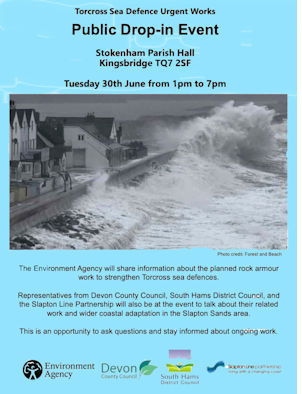 The Drop-in event was staffed by Environment Agency, Devon County Council, South Hams District Council, a construction company. All had Display Boards. There were a number of caveats and references to the fact that there could be changes to what was printed on the Display Boards.
COMMENT: Uninspiring, unscientific, far from reassuring. There was no evidence that the reason for the many breaches in the Shingle Ridge over the last 25 years had been analysed objectively. Somewhere, possibly Whitehall, had decided that rock armour was to be placed on the seaward side of the steel piling at Torcross. No attention to the consequences of such an action.
As has been noticed from the 400 walkers a few weeks ago, the great majority of people need an A-class road to be replaced. Many realise that continuing to throw boulders onto a dynamic shingle ridge is counter-productive, but some of the officers on duty were still uttering the Whitehall phrase of "holding the line".
The word "strengthen" was used in the advertisement for this event (see Left). This demonstrates clearly that Whitehall has little understanding of sea defences on dynamic shingle ridges. There are many beaches around Britain where government has used public money to install rock armour. It is often regarded as a cheap methodology. On beaches with less dynamic sediment structures, particularly on solid bed rock foundations, rock armour has been employed to reflect and provide some attenuation of wave energy. However, it has a limited lifespan as boulders are regularly displaced. It is not a sustainable methodology. Natural beaches are the best sea defence for a coastline.
In the case of Slapton Shingle Ridge, which is composed of a large amount of mobile sediment to depths of over fifteen metres, the 3.5 kilometre length was fully dynamic until the late 19th Century. Attempts to stiffen or "strengthen" the many millions of tons of loose material is actually preventing the ridge from responding to wave action, particularly in times of extreme storms. The A379 road and its hardcore base has been responsible for stiffening the whole structure, and is responsible for much reflectivity, which leads to scour and removal of the Shingle towards the Nearshore Zone.
As for lack of scientific analysis; no two beaches around the World are identical. Copying sea defence methodology from one coastal site to another is fraught with problems. Site specific scientific analysis is essential to identify the many processes that are operating, and interacting with one another. Cross-shore processes are particularly important in this context.
The approach of many construction organisations is inappropriate. Turning up with big machinery and unspecified materials, then proceeding to apply untested techniques is a recipe for unexpected results. The Slapton Shingle Ridge has already seen 25 years of boulder tipping. Remnants are still visible, and are respnsible for some of the severe damage caused in February 2026. Reflectivity and scour are massively increased in times of extreme wave events.
Some of the officers on duty and explaining proposals to the public were not entirely clear on the current policy. Hovering between phrases "holding the line" and "managed realignment". It appeared that some sort of briefing had been given to them, but their understanding of the coastal processes was weak. There was an atmosphere that the dutiful officers were fulfilling their role but were not sure, in their own minds, of the rigour of the case their Display Boards were making.
Career development may be hindered if the various officers depart from the "holding the line" policy. The problem they face is that the public do not square with the actions of the public servants over the last few years. They need a proper A class road.
6th July 2026 - an Environment Agency representative appeared on a BBC Spotlight evening news feature on Extreme Weather. The announcement was 55,000 tonnes of rock armour will be placed on the seaward side of Torcross Steel Piling Sea Wall to provide protection for the properties. No statement on the replacement of the A379 road, although the interviewer did raise the matter.
COMMENT: If this was an attempt to provide specification for the installation of the rock armour, then many questions remain.
July/August 2026 - Six "story boards" affixed to timber shuttering on a wave damaged building just North of the The Start Bay Inn. The boards have no information of who had written or published them. They are entirely unattributed.

COMMENT: The "story" focuses upon the history of the people of Torcross. However, today there are few local people living in the 50 (approximately) properties at risk of storm damage. On board 6 there is a statement that "New and improved sea defences will help dissipate the power of the waves before they reach the sea wall". Presumably refering to the proposed rock armour, but where is the evidence that there has been any scientific assessment of why the wave damage is now so severe. Do the proponents of this unattributed "story" understand that rock armour on mobile sediments is not sustainable. Some property owners at Torcross have asserted that copying the rock armour at nearby Beesands will solve all their problems. There are important differences between Beesands and Torcross. Beesands cottages are built upon solid bedrock whereas Torcross properties are built upon mobile shingle sediments. Torcross properties are also closer to the High Water mark.
3rd August 2026 - SIX MONTHS HAVE ELAPSED SINCE THE A379 ROAD WAS BREACHED
Total road closure of the A379 since 2001 now in excess of 2 years.
No information available yet on the replacement road.
COMMENT: Little more can be added until the council and the government announce their response.
18th August 2026 - Devon County Council publishes its funding bid for £19.62 million to repair and reopen the A379 road near Torcross. The bid goes to the Governments's Structures Fund. The DCC announcement states that "The plans would reinstate the collapsed section of road and improve its resilience to future storms".
COMMENT: How the plans will improve resilience to future storms is not disclosed. COASTAL RESEARCH stated in 2005 that there was no scientific analysis of why the breaches are occurring. Twenty five years have elapsed since the 2001 breaches yet solutions are still being proposed and enacted without any clear understanding of the causes of the breaches. Clearly, the breaches are made by storm waves, but why do the waves cause the most severe damage at locations where government agencies have installed the stiffest concrete and steel sea defences? COASTAL RESEARCH has presented explanations of some of the causes in these pages.
7th September 2026 - the construction company took over the Toilet and Tank car park, pedestian access to the Coast Path is being maintained. Security cameras positioned high on yellow poles have been installed.
12th September 2026 - Of the 21 properties on the Shingle Ridge and facing the sea, about 14 are boarded up and do not appear to be in use. Some have scaffolding erected. Those numerical estimates may not be exact as identifying individual properties may not be precise. Also, some properties may have been in use through Summer months but are now boarded up in preparation for winter gales.
16th October 2026 - the Marine Management Organisation, a government agency, issued the Marine Licence to install rock armour. The Licence may have been issued on 14th October 2026. To study their documentation, access their web site and type in the case reference MLA/2026/00346.
17th October 2026 - anticipated date of arrival of first large boulders at Torcross beach. This date was not met. Barometric Pressure over South Devon was High, over 1030 mb, and the seas were realtively calm for the time of the year.
22nd October 2026 - BBC Regional News at Breakfast Time announce that the Environment Agency have advised that delivery of large boulders will not be possible while strong winds and high waves persist.
23rd October 2026 - Torcross Beach may soon become unavailable as a public amenity. For a recent photo of the Beach before rock armour is installed see
Beach levels.
The Construction Company is currently occupying most of the Tank and Toilet Car Park. The Toilet is still available to the public, and the Coast Path is accessible via the Slapton Ley (West) side of the white metal compound walls.
The Start Bay Inn is not affected by these works. It is fully open and its car park is available for customers.
As of this date no large boulders had arrived by sea due to unfavourable weather conditions.
