
| HOME PAGE | |
| CONSULTANCY | |
| PUBLICATIONS | |
| > | TOPICAL - Slapton |
| Site Map |
e-mail enquiries to:
info@coastalresearch.co.uk
or write to:
Coastal Research, Tamarisks, Waresfoot Drive, Crediton, Devon, EX17 2DG, UK
or telephone:
+44 (0) 7814 101665
This page was updated on 19th March 2026.

Longshore drift has been drilled into school children by geography teachers for decades. If advancing waves arrive at a beach from a slight angle, then the up-beach wash, known as Swash, throws some pebbles, or sand particles, up the beach in the direction of the angled breaking wave. Some of the wave water percolates into the beach, but some flows back down the surface of the beach by gravity, dragging pebbles and sand with it. This is known as Backwash and it can assist some sediment to move towards the Nearshore Zone. After one wave cycle some pebbles have moved laterally, along the shore (the y direction), by centimetres or metres. Quantities moved are related to the size and direction of the waves.
Over the past 20 years the University of Plymouth have conducted intensive surveys of beaches in Start Bay to record beach levels. That data has been integrated to calculate volume of sediments. Multiple surveys at different times of the year have been compared with changing climate patterns. Results show how beach volumes have been moved both North and South. Reversals are common over time scales of less than one year to several years. Recently beach levels, and their corresponding volumes, have resulted in a build up of shingle at the Strete Gate (Northerly) end, and reduced volumes at the Torcross (Southerly) end.
Whereas Longshore Drift is one of the easier geomorphological processes to understand, Cross-Shore processes are significantly important to the changes in beach profiles. Changing wave characteristics are the dominant factor controlling Cross-Shore changes in beach profile. To illustrate this it is useful, initially, to consider waves reaching beaches at right angles.
Swash and Backwash both have the ability to move sediment (pebbles/sand) in the x direction. Wave Period, the interval, measured in seconds, between the arrival at a beach of successive waves can cause the amount of sediment washed up, and dragged back, to vary. If the wave period is long, say 14 or 16 seconds, then Swash transport is greater than Backwash transport. This is due to longer time available for water to percolate into the beach, meaning less energy for Backwash transport. Conversely, if wave period is short, say 6 or 8 seconds, then there is less time for percolation and Backwash transport potential is increased. Over many wave cycles this means that sediment on a beach can be moved into the Nearshore Zone, the underwater area below the Low Water Mark. A simple relationship is mostly true: Longer Period waves are termed Constructive; Shorter Period waves are termed Destructive.
Constructive waves build up beach sediments. Destructive waves drag sediments towards the Nearshore Zone, hence a beach profile becomes lower.
Cross-Shore processes are complex because of the number of controlling variables. These are:
Wave Period
Wave Height
Tidal Range
Tidal Streams
Sediment Characteristics
All of the above have sub-variables.
This makes successful Numerical Simulation
of beach processes difficult to achieve.
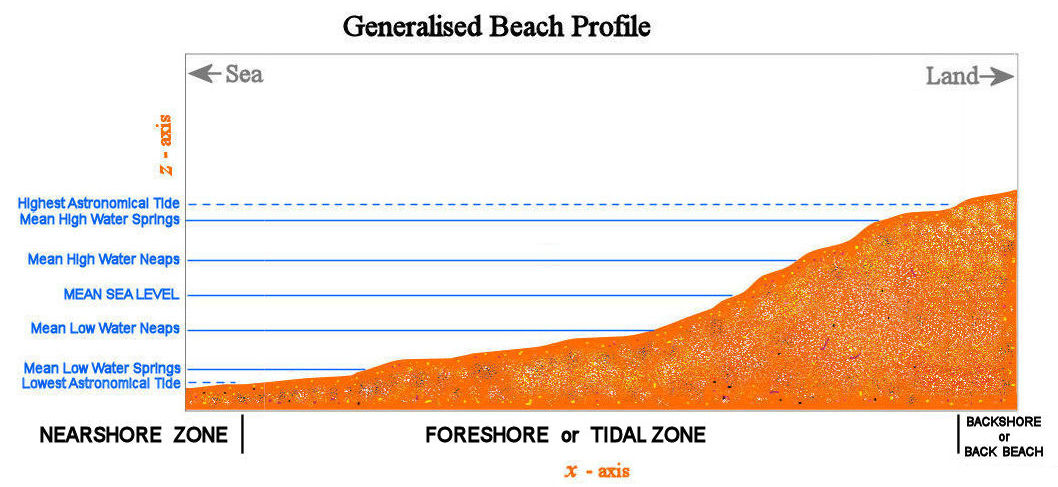
Beach profiles are a product of the variables. The profile is measured in the x direction (Cross-Shore). In simple terms sand particle beaches have flatter angles of slope than pebble beaches. In reality, many beaches have both sand and pebble zones. Wave energy is responsible for the sorting of particle sizes into zones. Westward Ho! beach in North Devon, near Bideford, provides an excellent example. It has a near flat sandy beach backed by a steep zone of large pebbles.
No two beaches in the world are identical!
The five principal variables listed above can be expanded and each have been the subject of extensive writing. This is why the study of beach changes over time should be undertaken by qualified specialists, rather than unqualified bureaucrats and construction companies. Sending in hydraulic machinery to make changes rarely proves advantageous in the long term, but has been employed at Slapton Shingle Ridge many times in the last few decades.